About Pixel Gem Adventure
Pixel Gem Adventure is the widest stage on the site — 2,100 pixels across, noticeably more than our other platformers — and the movement is deliberately heavier to match. Acceleration and braking are both lower than in Jewel Jump, which gives jumps a weight that suits exploring a large space rather than sprinting through a small one.
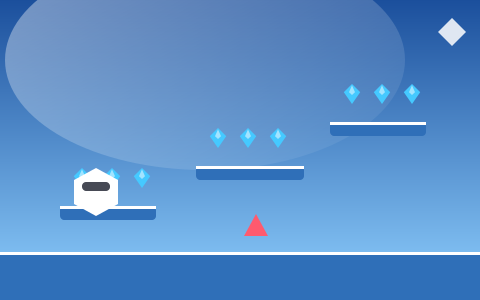
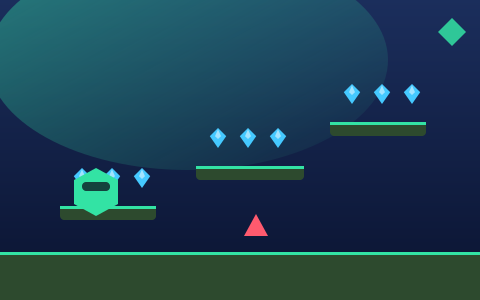
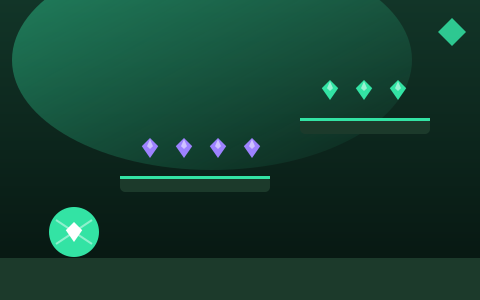
The presentation is retro without being a copy of anything: a chunky checkerboard backdrop drawn from canvas primitives, blocky platform edges and a squat green collector. It is our own take on the look rather than an imitation of a specific game, and nothing in it uses a character, sprite or level from anywhere else.
Because the stages are large and the gems are spread into corners, this is the platformer where routing matters most. There is no timer, but there is a lot of ground, and a player who plans a circuit finishes a stage in half the moves of one who backtracks.
How to play Pixel Gem Adventure
Objective
Explore a wide blocky stage and collect every gem on it, then move on to a larger one.
Keyboard
- ← → / A D — Run left and right
- Space / ↑ / W — Jump — hold for height
- P / Esc — Pause and resume
- M — Mute or unmute
- R — Restart once the run is over
Touch
- Left and right buttons — Run
- Jump button — Jump — hold for a higher jump
- Tap the play area — Start the run from the ready screen
What to avoid
Spikes on ledges, spinning cutters between platforms and drones drifting on fixed routes. A hit returns you to the stage entrance with your gems intact.
How to collect gems in Pixel Gem Adventure
Run or jump into gems to collect them. Each stage carries clusters over every platform, a long wave along the floor, and two to four high-value gems tucked above hazards or in far corners with warning rings. Because the stage is wide, several clusters are genuinely out of the way — reaching them is a decision about route order rather than about execution, which is what makes this the exploration platformer rather than the precision one.
Gems
The standard collectible, worth 10 points before your multiplier. The backbone of every streak.
Crystals
Worth 15 points. Usually laid out in trails and arcs rather than singly.
Treasure
Worth 35 points. Bar-shaped treasure gems mark a route worth a detour.
Diamonds
Worth 50 points. Bright white and always in an awkward position.
Power-ups
Gem Magnet
Pulls nearby gems toward you for eight seconds, so you can hold a streak through an awkward gap.
Shield
Absorbs one collision. Your run and your collection streak both survive the hit.
Gem Multiplier
Doubles the base value of every gem for eight seconds. Stacks on top of your combo multiplier.
Speed Boost
Increases your movement speed for six seconds. Faster routes, but less time to read what is ahead.
Scoring and combos
Base value times your combo multiplier, plus 400 for a stage clear and 300 more for clearing without a respawn. There is no timer and no time bonus, so the whole scoring model rewards thoroughness and an unbroken chain rather than pace.
Every five gems collected in a row raises your multiplier by one, to a ceiling of five times. A missed gem or an unshielded hit sends it straight back to one. Twenty gems collected as one unbroken chain is worth roughly three times the same twenty gems collected with breaks in between.
Standard streak rules, and on a stage this size an unbroken chain is a long commitment. The multiplier is at its ceiling long before the stage is finished, which means the back half of every stage is where the points actually accumulate — and why a careless hit at seventy per cent completion is the most expensive mistake in the game.
Difficulty
Medium. Gravity 2,100, jump power 760, acceleration 2,400 and braking 3,000 — heavier than Jewel Jump, lighter than Gem Jump Challenge. Stages add platforms, hazards and floor gaps as you clear them, and they get wider as well as busier. No timer and no double jump.
Tips for a better score
- Plan a circuit before you move. On a stage this wide, backtracking costs more than any individual gem is worth.
- Clear the far corners early. Leaving them for last means crossing the whole stage with a full multiplier at risk.
- The movement is heavy — start braking before the ledge, not on it.
- Take the multiplier power-up into a dense cluster rather than using it immediately.
- A hit at seventy per cent completion costs more than a hit at ten. Play the back half of a stage more carefully than the front.
- If you are struggling to find the last gem, check directly above and below the platforms you walked along. Clusters sit off the main line here more than in our other platformers.
Features
- The widest stages on the site at 2,100 pixels across
- Heavier movement tuned for exploration rather than sprinting
- Original chunky retro presentation drawn from canvas primitives
- Gem clusters placed off the obvious route to reward exploring
- No-respawn clear bonus on every stage
- Four power-ups: Gem Magnet, Shield, Gem Multiplier and Speed Boost
- Local best score, gem count and streak saved in your browser
- Full touch support with run and jump buttons
Frequently asked questions about Pixel Gem Adventure
Is this based on an existing retro game?
No. The chunky look is our own, drawn from canvas primitives, and every character, platform and gem in it was made for this site. No sprite, level or character from any other game appears here.
Why does the movement feel heavier than Jewel Jump?
Lower acceleration and lower braking, deliberately. The stages here are much wider, and heavier movement suits exploring a large space better than a twitchy one does.
Is there a time limit?
No. The stages are large and meant to be explored, so a clock would have pushed players into rushing past exactly the clusters that make them interesting.
Where are the gems I cannot find?
Usually directly above or below a platform you walked along. Clusters here sit off the obvious line more than in our other platformers, which is what makes this the exploration platformer.
Is there a double jump?
No. Every gap on every stage is reachable with a single well-positioned jump — if one feels impossible, try starting it from further back.