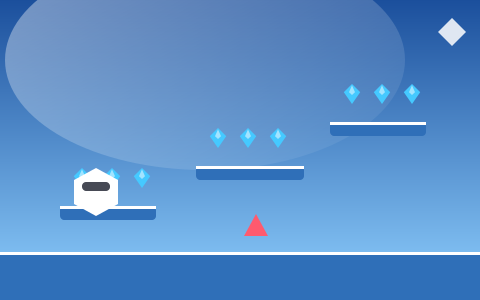
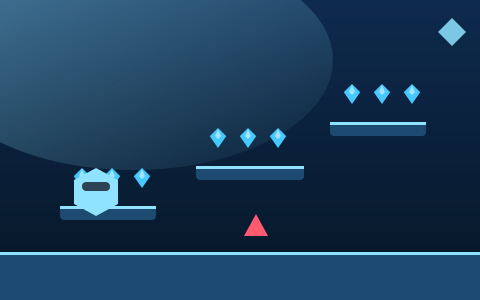
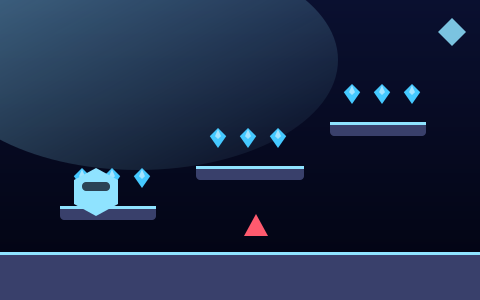
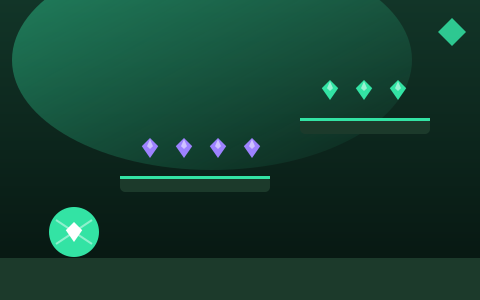
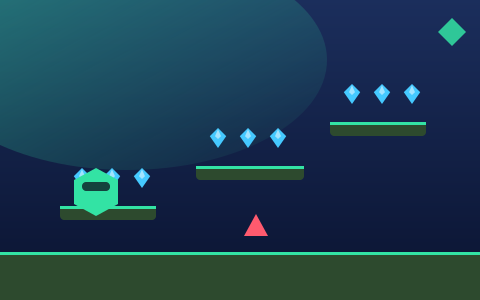
A gem collection platformer asks two questions at once: can you reach that ledge, and can you take the gems on the way? Everything in this category is built around that overlap. The platforms define where you can go, and the gem arcs define where you should go — and the two only agree if your jump is clean.
These are stage-based games rather than endless runs. Each stage contains a fixed number of gems, and clearing them all moves you on to a larger, faster layout. That structure means a run has a shape: an opening where you learn the platform spacing, a middle where you commit to a route, and an ending where the last few awkward gems decide whether you clear the stage on the first attempt.
If you are new to collection games, platformers are the friendliest place to start. Nothing moves until you do, so you can stand still, read the layout, and plan a route before committing — a luxury the endless categories never give you.
What defines this category
- Platforming and precise jump control
- Gem arcs placed along natural jump curves
- Obstacles that punish sloppy landings, not experimentation
- Stage-by-stage progression with clearable objectives
How these games work
Why gem arcs follow jump curves
In a well-built platformer, a line of gems in the air is not decoration — it is a drawing of the jump you are supposed to make. The apex of the arc sits at the apex of the jump, and the spacing matches the character's horizontal speed. This is why collecting every gem in an arc usually means you have executed the jump perfectly. Our platform stages place gem arcs with exactly that rule, so if you are clipping the first gem and missing the last two, your jump is starting too late rather than being too short.
Variable jump height and why it matters
Every platformer on this site uses a variable-height jump: tap the button for a short hop, hold it for the full arc. This single mechanic is what separates a platformer that feels precise from one that feels floaty. It means you can adjust mid-press, and it turns a single button into an analogue control. If you find yourself overshooting small ledges, you are almost certainly holding the jump longer than you need to.
Coyote time and jump buffering
Two invisible affordances make platformers fair. Coyote time gives you a fraction of a second to still jump after walking off an edge. Jump buffering registers a press made slightly before you land, so it fires the moment you touch down. Both exist because human timing is not frame-perfect and punishing that fact is not difficulty, it is noise. Our platformers use roughly 0.12 seconds of each.
Moving platforms change the whole plan
Once platforms drift, a route stops being a fixed sequence and becomes a timing problem. The important habit is to read the platform's direction before you jump, not while you are in the air, because mid-air steering is deliberately weaker than ground movement in every platformer here. Games like Jewel Jump and Moon Crystal Hopper introduce drifting platforms early so that habit forms while stages are still forgiving.
Risk gems and when to skip them
Most stages hide one or two high-value gems above a hazard or across a long gap. They are marked with a warning ring. Taking them is worth roughly four or five ordinary gems, but losing your run costs everything banked. The rule that serves most players: take risk gems early in a stage when your streak is short and there is less to lose, and skip them late when your multiplier is already at its ceiling.
Tips that work across the category
- Walk to the edge before you jump. Starting a jump from the very lip of a platform gives you the full horizontal distance.
- Tap for short hops. Holding the button is the exception, not the default.
- When a gem arc has a gap in the middle, that gap is usually where a hazard passes. Watch one full cycle before you commit.
- Clear the awkward gems first. Leaving them until last means attempting the hardest jump under time pressure with everything to lose.
- If you fall repeatedly on the same jump, change your approach speed rather than your jump timing. Nine times out of ten the problem is that you arrive at the edge too slowly.
Frequently asked questions about Gem Collection Platformers
Do I need to collect every gem to finish a stage?
In most of our platformers, yes — the stage clears when the last gem on the layout is collected. Games with an exit portal, like Moon Crystal Hopper and Gem Jump Challenge, open the exit once the gems are gone and then ask you to reach it.
Are these games playable on a phone?
Yes. Every platformer here shows on-screen left, right and jump buttons on touch devices, placed below the play area so they never cover the canvas or the score.
What happens if I fall off the stage?
You respawn at the stage entrance and your collection streak resets, but the gems you already collected stay collected. A fall costs you your multiplier, not your progress.
Is there a way to save my progress between sessions?
Your best score, best gem count and best streak for each game are saved in your browser's local storage. The stage you were on is not saved — every run starts from stage one, which is deliberate for an arcade game.