About Space Gem Collector
Space Gem Collector is a one-button flyer built on a deliberately unhelpful physics model. Thrust pushes you up; release and gravity takes over. There is no drag, no auto-levelling and no stabiliser, so every burst of thrust has to be paid back with a corresponding pause. If you over-thrust, you do not drift back — you arrive at the ceiling.
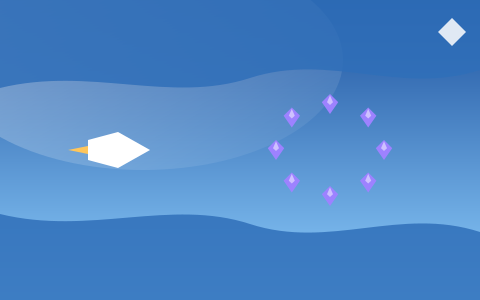
The gem rings are what make this worth learning. Every few seconds the generator places a ring of ten energy stones somewhere in the field, and a ring is only worth full value if you pass through it cleanly in one arc. That means picking your approach height several seconds before you get there, which is exactly the skill the physics model is testing.
It plays quite differently from Sky Gem Collector despite both being open-sky flyers. There, you point at where you want to be. Here you have to plan a trajectory and then fly it.
How to play Space Gem Collector
Objective
Fly an open star field, thread the gem rings and stay clear of drifting debris with only one control.
Keyboard
- Space / ↑ / W — Hold to thrust upward — gravity pulls you down when released
- P / Esc — Pause and resume
- M — Mute or unmute
- R — Restart once the run is over
Touch
- Thrust button — Hold to climb
- Hold the play area — Also thrusts, so you can fly one-handed
- Tap the play area — Start the run from the ready screen
What to avoid
Tumbling boulders and unstable energy orbs drifting in from the right, many of them patrolling a visible vertical range. There are no walls — only the top and bottom of the screen.
How to collect gems in Space Gem Collector
Fly into gems to collect them. The field carries wave and arc patterns of gems and energy stones, plus a full ring every four to eight seconds. A ring taken as one clean arc is worth ten energy stones in an unbroken chain, which is usually enough on its own to step the multiplier twice. The Gem Vacuum power-up is unusually valuable here, because it can salvage a ring you entered at a bad angle.
Gems
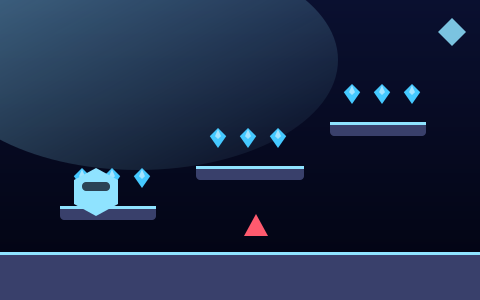
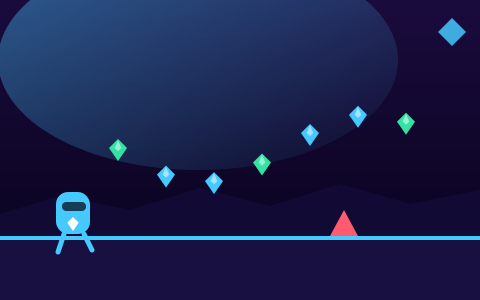
The standard collectible, worth 10 points before your multiplier. The backbone of every streak.
Crystals
Worth 15 points. Usually laid out in trails and arcs rather than singly.
Diamonds
Worth 50 points. Bright white and always in an awkward position.
Jewels
Worth 25 points. Hexagonal, and usually placed just past an obstacle.
Power-ups
Gem Magnet
Pulls nearby gems toward you for eight seconds, so you can hold a streak through an awkward gap.
Shield
Absorbs one collision. Your run and your collection streak both survive the hit.
Gem Vacuum
Sweeps up every gem in a wide radius automatically for five seconds.
Gem Multiplier
Doubles the base value of every gem for eight seconds. Stacks on top of your combo multiplier.
Scoring and combos
Base value times your combo multiplier, plus a distance trickle. The rings are the scoring backbone: a run that threads most of its rings cleanly will roughly double the score of a run that clips them, at the same distance. Energy stones are worth twenty points each, double a plain gem.
Every five gems collected in a row raises your multiplier by one, to a ceiling of five times. A missed gem or an unshielded hit sends it straight back to one. Twenty gems collected as one unbroken chain is worth roughly three times the same twenty gems collected with breaks in between.
Standard rules, with one wrinkle: a ring is ten gems, so entering one with a broken chain and exiting with the multiplier at three is very common. Because of that, clean ring entry is worth more than any individual pickup in the game — the chain it starts is what pays.
Difficulty
Medium. Scroll speed runs from 270 to 560 over about 100 seconds. Gravity is 780 against a thrust of 1,650, which gives a responsive but heavy feel. Hazards drift with visible patrol ranges and there is no corridor to clip, so almost every failure is a momentum failure rather than an ambush.
Tips for a better score
- Thrust in short taps, not long holds. Long holds are what put you into the ceiling.
- Plan your ring entry while the ring is still entering the screen. Entering at a bad angle wastes most of its value.
- Aim for the centre of a ring, not the edge. A centred arc collects all ten stones; a clipped one takes three.
- Save the vacuum for a ring you know you have approached badly. It is the only way to salvage one.
- Let gravity do the descending. Fighting it with more thrust just uses energy you will have to shed later.
- Cross behind a patrolling hazard, and use the moment it is at the far end of its range.
Features
- One-button thrust physics with no drag and no auto-levelling
- Gem rings that reward planning a clean entry arc
- Energy stones worth double a plain gem
- Four power-ups including Gem Vacuum, which can rescue a bad ring entry
- Open field with no corridor walls — every failure is a momentum failure
- Local best score, gem count, streak and distance saved in your browser
- Playable one-handed on touch by holding anywhere on the canvas
- Reduced-motion support that cuts particle counts and screen shake
Frequently asked questions about Space Gem Collector
Why does my ship keep hitting the ceiling?
Because there is no drag. Thrust adds upward velocity that nothing removes except gravity, so a long hold keeps climbing after you release. Short taps are the whole technique.
How much is a gem ring worth?
Ten energy stones at twenty points each, before your multiplier — and taken as one unbroken chain, it usually steps the multiplier twice. A clean ring is the single biggest scoring event in the game.
How is this different from Sky Gem Collector?
Sky Gem Collector gives you direct positional control; you point and it goes there. Here you control acceleration, not position, so you have to plan trajectories several seconds ahead.
Are there walls to crash into?
No. It is an open field — only the top and bottom of the screen stop you. Rocket Gem Run is the corridor flyer if you want walls.
Can I play this with one hand on a phone?
Yes. Holding anywhere on the play area thrusts, so the entire game is one thumb.