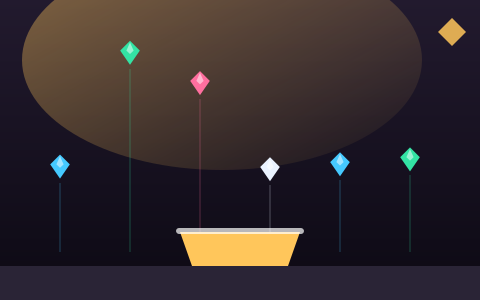
About Crystal Conveyor
Crystal Conveyor is a lane game dressed as industrial machinery, and the machinery is not just decoration. The belts are visible, they run at a fixed speed, and the plates on them move at a rate that matches the arrival of everything they carry. The result is a rhythm you can feel rather than a stream of events you have to react to.
Because the arrival rate is mechanical rather than random, the game rewards counting. Strong players do not watch the individual crates — they feel the interval and move on the beat, which is why a good Crystal Conveyor run looks calmer than a good Rainbow Jewel Quest run even though the two use the same three-lane structure.
The crystal lines are the reward for reading correctly. Every wave places a line of two to four crystals on the clear belt, so a player on the right belt at the right moment sweeps the whole line without touching the controls again.
How to play Crystal Conveyor
Objective
Ride the belt that is carrying crystals, move off the belts carrying scrap, and keep the chain going.
Keyboard
- ↑ / W — Move to the belt above
- ↓ / S — Move to the belt below
- P / Esc — Pause and resume
- M — Mute or unmute
- R — Restart once the run is over
Touch
- Up and down buttons — Change belts
- Swipe up or down on the play area — Change belts — faster than the buttons
- Tap the play area — Start the run from the ready screen
What to avoid
Crates, blocks and spinning cutters riding the belts toward you. One belt in every wave is always clear.
How to collect gems in Crystal Conveyor
Ride into crystals to collect them. The clear belt in each wave carries a line of crystals, gems or occasionally jewels; the blocked belts carry scrap and the occasional stray single. A rare gem with a warning ring appears roughly one wave in twelve, usually two belts away from where you are. Anything that passes you uncollected counts as a miss, so switching late costs a whole line rather than one crystal.
Crystals
Worth 15 points. Usually laid out in trails and arcs rather than singly.
Gems
The standard collectible, worth 10 points before your multiplier. The backbone of every streak.
Jewels
Worth 25 points. Hexagonal, and usually placed just past an obstacle.
Treasure
Worth 35 points. Bar-shaped treasure gems mark a route worth a detour.
Power-ups
Gem Magnet
Pulls nearby gems toward you for eight seconds, so you can hold a streak through an awkward gap.
Shield
Absorbs one collision. Your run and your collection streak both survive the hit.
Gem Multiplier
Doubles the base value of every gem for eight seconds. Stacks on top of your combo multiplier.
Scoring and combos
Base value times your combo multiplier, plus a distance trickle. There is no stage bonus here — unlike Rainbow Jewel Quest, this game scores purely on the chain, which suits its steadier rhythm. Long, unbroken runs at a five-times multiplier are where the scoring is.
Every five gems collected in a row raises your multiplier by one, to a ceiling of five times. A missed gem or an unshielded hit sends it straight back to one. Twenty gems collected as one unbroken chain is worth roughly three times the same twenty gems collected with breaks in between.
Standard streak rules, made unusually holdable by the fixed rhythm. Because the interval between waves is consistent and the clear belt is always signposted by its crystal line, an experienced player can hold a five-times multiplier for minutes. If your chain keeps breaking, you are moving on the arrival rather than on the beat.
Difficulty
Medium. Speed climbs from 300 to 600 over about a hundred seconds, spawn gaps tighten from 1.2 seconds to 0.48, and blocker density rises from thirty-four to eighty per cent. Three belts mean every switch is one move. The belt plates speed up alongside everything else, so the rhythm accelerates rather than changing shape.
Tips for a better score
- Move on the beat, not on the object. The interval is fixed, so counting is more reliable than reacting.
- The crystal line marks the clear belt. If you can see where the crystals are, you already know where to be.
- Swipe rather than tapping buttons on a phone. It keeps your thumb where you can still see the screen.
- Do not chase a rare gem two belts away. Two moves at speed is how chains break.
- Watch the belt plates in your peripheral vision — they accelerate visibly, which is your warning that the interval is tightening.
- If you are breaking chains in the same place every run, you are switching a beat late. Move one interval earlier from that point.
Features
- Three conveyor belts with visible moving plates
- Fixed mechanical rhythm you can count rather than react to
- Exactly one clear belt per wave, signposted by its crystal line
- Swipe and button controls, both fully supported
- Three power-ups: Gem Magnet, Shield and Gem Multiplier
- Pure chain scoring with no stage bonuses to chase
- Local best score, crystal count, streak and distance saved in your browser
- Two-button control scheme suitable for one-handed play
Frequently asked questions about Crystal Conveyor
Is there always a clear belt?
Yes. Every wave leaves exactly one belt free, and that belt carries the crystal line. You can identify it by looking for the crystals rather than by checking each belt for scrap.
How is this different from Rainbow Jewel Quest?
Same three-lane structure, different pacing. This one runs on a fixed mechanical rhythm with visible belts and no stage bonuses; Rainbow Jewel Quest escalates in stages and runs faster at the top end.
Why should I count the rhythm instead of reacting?
Because the arrival interval is constant within a difficulty band. Counting gives you a consistent early move; reacting gives you a variable late one.
Should I go after the rare gems?
Only when they are one belt away. A rare gem is worth ten ordinary crystals, but a two-move switch at speed usually breaks a chain worth more than that.
Do the belts actually do anything mechanically?
They set the pace. The plates move at a rate tied to the current speed, so the visual rhythm and the arrival rhythm are the same thing — which is what makes counting work.