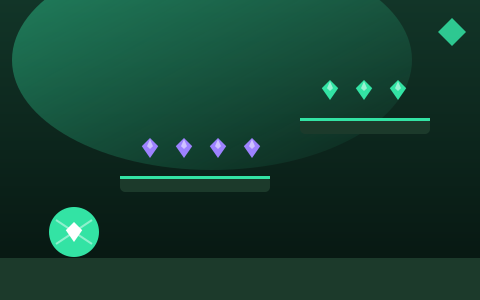
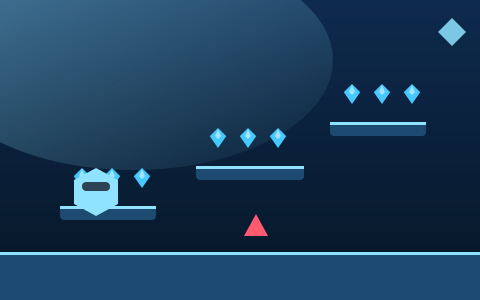
A rolling character sits between a platformer and a vehicle. It does not stop when you stop pressing, it does not turn sharply, and it gains speed slowly. Those three properties change what a collection level has to look like.
What rolling changes
Rolling Gem Quest uses acceleration of 1,250 toward a maximum of 460, with friction at 0.022. For comparison, our standard platformer accelerates at 2,900 and decelerates at 3,400.
So: half the acceleration, and almost no deceleration at all. The sphere takes a while to get going and then keeps going.
Three consequences.
Acceleration becomes a plan. You cannot decide to be fast at the moment you need to be fast. Reaching cruising speed takes a second or so, which means the decision happened earlier.
Direction changes are expensive. Reversing means decelerating through zero and accelerating back, which at these values is slow. A route with many reversals is a bad route regardless of how many gems it touches.
Collecting becomes sweeping. A rolling character cannot pick at a cluster. It passes through, or it does not.
That last one is the important one, because it dictates the layout.
Spacing for cruising speed
Every chamber in Rolling Gem Quest contains a long wave of gems arcing through the open middle, spaced at 74 pixels.
That number is derived rather than chosen. At a cruising speed of around 400 pixels per second, 74-pixel spacing gives a pickup roughly every 0.18 seconds — fast enough to feel continuous, slow enough that each one registers.
The important property is what happens at other speeds. At a standstill, the wave is a series of separate objects a long way apart, and collecting them means a sequence of short accelerations and decelerations that the physics makes miserable. At cruising speed it is one smooth sweep.
So the layout is not merely compatible with momentum — it requires momentum. The game teaches its own mechanic through the placement of its rewards, which is a much better way to teach than an instruction would be.
This is the general principle for any momentum-based collection game: space the collectibles for the speed the player will actually be travelling. A wave spaced for a stationary character is either trivial or impossible for a moving one.
Walls punish bad acceleration
A rolling game needs a cost attached to reckless acceleration, or the optimal strategy becomes holding a direction and ricocheting around the chamber.
Ours is the wall bounce: hitting a boundary reverses your horizontal velocity at about half its magnitude, and you lose control for the moment it takes to settle.
That is a meaningful penalty. Half your speed is a second or more of acceleration to rebuild, and in a game where collection requires cruising speed, arriving at a gem wave at half pace means missing most of it.
The practical rule: build speed toward open space, not toward edges. Look at where your acceleration is taking you before you commit to it, and if there is a wall at the end of it, either accelerate less or accelerate later.
The related affordance is that the hop works from any surface you are touching, including walls. That opens routes that are not obvious at first — a wall you were about to bounce off can instead be a launch point, which converts a penalty into an option.
Plan circuits, not sequences
Because direction changes are expensive, route planning in a rolling game is different from route planning anywhere else.
In a platformer, a route is a sequence: go here, then there, then there. Reversing costs a second and nothing else.
In a rolling game, a route wants to be a circuit — a loop through the chamber that touches most of the gems and returns roughly to where it started without reversing. Each chamber usually has one, and finding it before moving is worth several seconds.
Three habits that follow:
Look before you accelerate. Chambers are visible in full. Spend two seconds identifying a loop rather than discovering the layout while already moving.
Take the mid-chamber wave in one pass. It is the hardest thing to collect and the easiest to ruin by hesitating. Commit to it as a single movement.
Let the sphere coast into clusters. Accelerating into a cluster overshoots it; arriving at cruise passes through it. The speed trail — which appears above about 280 pixels per second — is a useful confirmation that you are travelling fast enough for the long waves and not so fast that you will overshoot the ledge clusters.
If rolling appeals, Gravity Crystal Hunt is the same physics with a second axis added: both surfaces are solid and you can flip which way gravity pulls, so a circuit can run along the ceiling as easily as the floor.
Key takeaways
- A rolling character accelerates slowly and keeps going, so acceleration is a plan rather than a reaction.
- Mid-chamber gem waves are spaced for a sphere at cruising speed and are nearly uncollectable while stopping and starting.
- Wall bounces cost half your speed and brief control, which makes accelerating toward edges a real mistake.
- Route planning becomes a circuit problem rather than a sequence of moves.
Frequently asked questions
Why does the sphere keep rolling?
Light friction, by design. Momentum is the intended mode of travel, and the gem layouts are spaced for a sphere that is already moving.
How do I collect the wave through the middle of the chamber?
Build speed along a ledge first, then take the whole wave in one continuous pass. Picking at it a gem at a time is why it feels impossible.
What happens when I hit a wall?
You bounce off at about half speed and lose control briefly. Accelerating toward chamber edges is the most common way runs go wrong.
Can I hop off a wall?
Yes. The hop works from any surface you are touching, including walls, which opens routes that are not obvious at first.
Put it into practice
Reading about collection routes only gets you so far. Pick a game and try one idea from this guide on your next run.