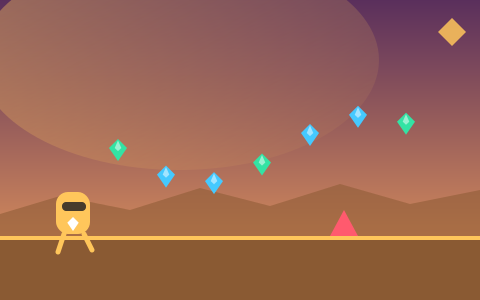
Rush games are about rate. Not just how many gems you collect, but how quickly you collect them and how long you keep the chain unbroken. Everything else — the speed, the obstacles, the layouts — exists to put pressure on that chain.
The combo system is the same everywhere on this site: every five gems collected in a row raises your multiplier by one, up to five times, and any miss or hit sends it back to one. In a rush game, that rule is the whole strategy. The difference between a mediocre run and a great one is almost never the number of gems collected; it is the multiplier that was active while you collected them.
Several games in this category add a momentum layer on top. Gem Rush has a rush meter that fills with your streak and visibly accelerates the world when full. Magnet Gem Rush lets you trade speed for collection reach. In both cases the mechanic exists to make the chain feel like it is doing something, rather than just counting.
What defines this category
- Fast collection under time and speed pressure
- Combo streaks and multiplier management
- Momentum mechanics that reward aggression
- Short, repeatable runs built for score chasing
How these games work
The multiplier maths, plainly
Points for a gem equal its base value multiplied by your current multiplier, and multipliers step up every five consecutive gems to a ceiling of five. Twenty gems collected with the chain broken every four gems is two hundred points. The same twenty collected as one unbroken chain is 540, because the multiplier climbs through the chain. That gap is why protecting a streak matters more than finding extra gems.
Rush meters and momentum
Gem Rush fills a meter as your streak grows. At full rush, the world speeds up by about twelve per cent and every gem pays a bonus on top of the multiplier. The speed increase is not a penalty — it is the cost that makes the bonus meaningful, and it is why full rush is thrilling rather than free. Letting the streak lapse drains the meter gradually rather than instantly, so a single mistake is recoverable.
Trading speed for reach
Magnet Gem Rush is built on one decision you make continuously: hold the charge button to widen your magnet field and collect gems you could not otherwise reach, at the cost of roughly twenty per cent of your speed. Wide and slow collects more per metre; narrow and fast covers more metres. Neither is correct — the answer changes with the density of the gem layout in front of you.
Why rush games are short by design
A rush run is meant to be attempted many times. Short runs mean a failed attempt costs little, which in turn means you can afford to play aggressively and learn where the limits are. If every run took ten minutes, nobody would take the risky line — and the risky line is where the interesting play lives.
Reading density instead of reacting to gems
Strong rush players do not chase individual gems. They read the shape of the field a second ahead and pick a line that intersects the most gems with the fewest direction changes. Every direction change costs speed, and in a rush game speed is score. Practise by deliberately ignoring isolated gems that sit off your line — you will usually finish with more points, not fewer.
Tips that work across the category
- Chain first, collect second. Five ordinary gems in a row beat two valuable gems with a break between them.
- Do not reverse for a missed gem. The time and speed cost is almost always more than the gem is worth.
- Keep the multiplier readout in your peripheral vision, not your focus. If you are reading it, you are not reading the field.
- In Magnet Gem Rush, charge in the gaps between clusters, not inside them — you want the field wide before the gems arrive.
- Restart early. A run that has already lost its streak in the first fifteen seconds is worth abandoning.
Frequently asked questions about Gem Rush Games
How high can the multiplier go?
Five times. It steps up every five gems in an unbroken chain — x2 at five, x3 at ten, x4 at fifteen and x5 at twenty. The ceiling exists so that a very long chain does not turn into an unreachable score nobody can match.
What breaks my streak?
Letting a gem leave the play area uncollected, taking a hit that a shield does not absorb, or — in a handful of games — letting the streak timer lapse. The HUD shows your current multiplier at all times.
Does going faster actually score more?
Indirectly. Speed earns a small distance bonus, but its real value is that it puts more gems in front of you per second. A fast run with a broken chain still loses to a slower run with a x5 multiplier.
Which rush game has the highest scoring ceiling?
Gem Collector Ultimate, because its treasure phase puts high-value gems on the board while your multiplier is already established. It is also the hardest place to keep a chain alive.