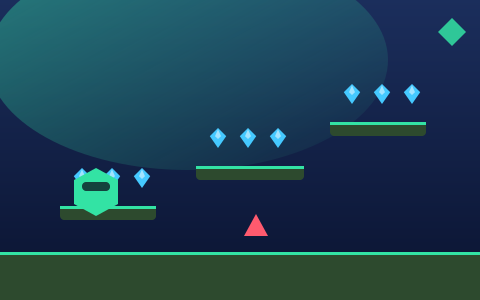
Reflex games strip the control scheme down until only timing is left. Some use a single button. Some use one axis of movement. None of them ask you to remember a layout or plan a route — they ask whether you can act at the right moment, repeatedly, as the moments get closer together.
This is the category with the shortest learning curve and the longest mastery curve. One-Tap Gem Collector can be explained in a sentence: tap to flip which surface you fall toward. Playing it well for three minutes is genuinely difficult, because every pattern is a decision about when to flip rather than whether to.
Reflex games are also the most honest test of whether a game is telegraphing properly. With one input and no route planning, there is nowhere for unfair design to hide. If a player cannot react in time, either the warning was too short or the pattern was unreadable — and both are our fault, not theirs.
What defines this category
- Reaction speed and timing precision
- One-tap and single-input control schemes
- Quick decisions with immediate consequences
- Simple rules with a high skill ceiling
How these games work
One input, many meanings
A single-input game works when the one input does something rich. Flipping gravity is a good example: the same tap means 'go up' and 'go down' depending on context, and the consequence unfolds over the following second rather than instantly. That delay is what creates skill — you are not reacting to the current frame, you are committing to the next one.
Reaction windows and fair difficulty
Human simple reaction time is typically somewhere around a fifth of a second, and choice reaction — deciding between two responses — is meaningfully slower. Designing a reflex game means keeping the window above that threshold even at maximum difficulty. Ours narrow as the run progresses but stop at roughly a third of a second, which leaves room to perceive, decide and act rather than guess.
Precision over speed
Gem Jump Challenge is the precision end of this category: small platforms, no double jump, and gem arcs placed exactly on the ideal jump curve. Nothing moves fast. The difficulty is entirely in how little margin each landing has. It is the best game here for diagnosing whether your problem is reaction time or control accuracy — if you fail at low speed, it is accuracy.
Why patterns beat randomness
Reflex games feel unfair when the next event is unpredictable, and feel skilful when it is predictable but demanding. Our one-tap patterns always place the gems on one surface and the hazard on the other, so every pattern asks a single clear question. That consistency is what lets a player improve, because improvement means learning to answer the question faster.
Training your reactions with these games
Short, repeatable runs with immediate feedback are reasonable reaction practice, as long as you play deliberately rather than mindlessly. Focus on one thing per session — reacting earlier, or moving more precisely, not both. And stop when your runs get consistently worse: fatigue makes reaction times worse, and grinding through it trains bad habits rather than good ones.
Tips that work across the category
- Act on the pattern, not on the gem. Decide what the pattern requires, then collect what that decision makes available.
- Flip or move early. Being a fraction early is almost always survivable; being a fraction late almost never is.
- In one-tap games, count your flips. Fewer flips per gem means a cleaner line and usually a longer run.
- Play in short sessions. Reaction-based skill degrades quickly with fatigue and recovers with a break.
- Turn the sound on. The audio cue for a collected gem arrives faster than the visual one and helps you feel the rhythm.
Frequently asked questions about Reflex & Collection Games
Can these games improve my reaction time?
They can sharpen how quickly you recognise and respond to specific familiar patterns, which is real but narrow. Broad, lasting improvement in general reaction speed is a much bigger claim and not one we would make for an arcade game.
Do one-tap games work on a keyboard?
Yes. Space, Enter, the Up arrow and a click all do the same thing, and on touch devices a tap anywhere on the play area works too.
Why does the game get faster and not harder in other ways?
Because speed is the honest variable in a reflex game. Adding extra rules mid-run would change what skill is being tested; shortening the reaction window tests the same skill more severely.
Which game is the best starting point?
One-Tap Gem Collector. It has one rule, one control, and patterns that always ask a single clear question. Gem Jump Challenge is the hardest thing in this category and worth saving for later.