About Rainbow Jewel Quest
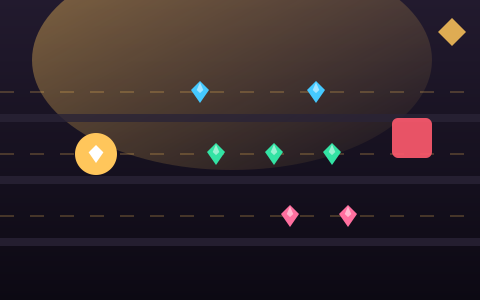
Rainbow Jewel Quest reduces movement to a single question: which of three lanes are you in? There is no jumping, no height, no fine positioning. Each wave arrives with one lane guaranteed safe and carrying a jewel line, and the other two holding some mix of jewels, blockers and nothing.
That constraint makes it the purest test of reading ahead on the site. Because the wave is visible from the moment it enters the screen, every failure is a decision made too late rather than a reaction missed. Strong players switch as soon as a wave appears; weaker ones switch when it arrives, which at higher speeds is the same thing as not switching.
A stage announcement fires every twenty-five seconds with a bonus attached, so the run has a visible structure rather than a smooth blur. Each stage raises the speed, tightens the spacing and increases the chance that two lanes are blocked rather than one.
How to play Rainbow Jewel Quest
Objective
Pick the right lane, sweep the jewel lines arriving in it, and keep switching as the pace escalates each stage.
Keyboard
- ↑ / W — Switch to the lane above
- ↓ / S — Switch to the lane below
- P / Esc — Pause and resume
- M — Mute or unmute
- R — Restart once the run is over
Touch
- Up and down buttons — Switch lanes
- Swipe up or down on the play area — Switch lanes — faster than the buttons
- Tap the play area — Start the run from the ready screen
What to avoid
Blocks, spinning cutters and energy barriers occupying the lanes you should not be in. Exactly one lane in every wave is always clear.
How to collect gems in Rainbow Jewel Quest
Drive into jewels to collect them. The safe lane in every wave carries a line of two to four jewels, crystals or occasionally diamonds, and the other lanes carry scattered singles when they are not blocked. A rare gem with a warning ring appears roughly one wave in twelve, usually in a lane that is awkward to reach from where you are. Jewels that leave the left edge uncollected count as misses, so a late switch costs you a line rather than just a position.
Jewels
Worth 25 points. Hexagonal, and usually placed just past an obstacle.
Gems
The standard collectible, worth 10 points before your multiplier. The backbone of every streak.
Crystals
Worth 15 points. Usually laid out in trails and arcs rather than singly.
Diamonds
Worth 50 points. Bright white and always in an awkward position.
Power-ups
Gem Magnet
Pulls nearby gems toward you for eight seconds, so you can hold a streak through an awkward gap.
Gem Multiplier
Doubles the base value of every gem for eight seconds. Stacks on top of your combo multiplier.
Shield
Absorbs one collision. Your run and your collection streak both survive the hit.
Speed Boost
Increases your movement speed for six seconds. Faster routes, but less time to read what is ahead.
Scoring and combos
Base value times your combo multiplier, plus a distance trickle and a stage bonus of 150 points times the stage number every twenty-five seconds. The stage bonus compounds — reaching stage six is worth considerably more than reaching stage three twice — which pushes the game toward survival once your multiplier is at the ceiling.
Every five gems collected in a row raises your multiplier by one, to a ceiling of five times. A missed gem or an unshielded hit sends it straight back to one. Twenty gems collected as one unbroken chain is worth roughly three times the same twenty gems collected with breaks in between.
The standard rule, sharpened by lane geometry: because jewels arrive in lines, missing the front of a line usually means missing the whole thing. Switching a fraction early gets you the full line; switching a fraction late gets you nothing and resets the multiplier. This is the game where 'move earlier' pays most directly.
Difficulty
Medium. Speed climbs from 320 to 660 over roughly ninety seconds, spawn gaps tighten from 1.1 seconds to 0.45, and hazard chance rises from thirty to seventy-eight per cent. Three lanes mean a switch is always one move, which keeps the control demand low even when the pace is high — the four-lane version of this idea is Ultimate Gem Challenge.
Tips for a better score
- Switch the moment a wave enters the screen, not when it arrives. At higher speeds those are the same instant.
- Swipe rather than tapping the buttons on a phone. It is faster and it does not move your thumb off the screen.
- Take the safe lane even when a neighbouring lane has a diamond in it. A broken streak costs more than a single diamond pays.
- Watch two waves ahead once you are comfortable. The wave behind the current one determines whether you should switch now or hold.
- Stage bonuses compound, so once you have a five-times multiplier, prioritise surviving to the next announcement.
- If you are dying at the same stage every run, start switching one wave earlier from that stage onward.
Features
- Three lanes with exactly one guaranteed safe lane per wave
- Swipe and button controls, both fully supported
- Stage announcements with compounding bonuses every twenty-five seconds
- Jewel lines that reward switching early rather than reacting
- Four power-ups: Gem Magnet, Gem Multiplier, Shield and Speed Boost
- Rolling lane guides that visualise speed without a readout
- Local best score, jewel count, streak and distance saved in your browser
- Two-button control scheme suitable for one-handed play
Frequently asked questions about Rainbow Jewel Quest
Is there always a safe lane?
Yes. Every wave guarantees exactly one clear lane, and that lane carries the jewel line. A wave with no way through would be an ending, not an obstacle.
What is the fastest way to switch lanes?
Swiping up or down on the play area, on touch. On a keyboard the up and down arrows are instant, and the lane change animates over about a third of a second.
What happens at a stage change?
A banner announces the new stage and awards 150 points times the stage number. Speed, spacing and blocker density all step up at the same moment.
Should I ever leave the safe lane?
Occasionally — a rare gem is worth a hundred points, ten ordinary jewels. But leaving a jewel line to get it usually breaks your streak, which costs more than it pays once your multiplier is high.
How is this different from Crystal Conveyor?
Same three-lane structure, different feel. Crystal Conveyor arrives on belts with visible plates and a mechanical rhythm; this one escalates in stages and runs faster at the top end.