The most common reason someone tries a collection game and does not come back is that they started with the wrong one. Expert-tier games are not harder versions of easier games — they assume habits that take a few runs to build, and playing one first is simply unpleasant.
What makes a good first game
Four properties, and the more of them a game has the better a starting point it is.
Slow enough that misses are decisions. If a game is fast enough that you are reacting rather than choosing, you cannot learn from your mistakes because you cannot identify them. Every miss needs to be traceable to something you chose.
Continuous collectibles rather than scattered ones. A trail or a line teaches line-holding; scattered pickups teach chasing, which is the habit you eventually have to unlearn.
Some forgiveness built in. A permanent magnet, a wide catcher, generous jump timing — anything that means being approximately right is good enough while you are calibrating.
Low or no time pressure. Time pressure prevents the single most useful beginner behaviour, which is looking at the layout before moving.
Five to start with
Forest Gem Trail — easy, endless runner. The best single starting point on the site. It has the slowest top speed of our runners, the lowest hazard density, a fourteen-gem ribbon in every chunk, and a small permanent magnet. It exists to let a new player feel a five-times multiplier held for a minute, which is the habit everything else is built on.
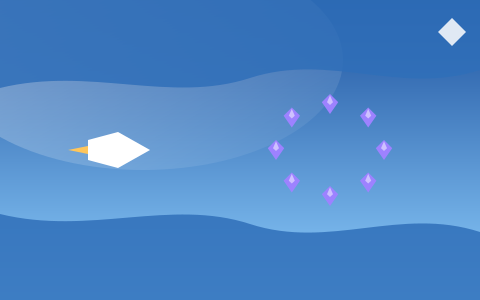
Sky Gem Collector — easy, open-sky flyer. No walls, no corridor, slow-drifting hazards, and direct control of your height. Because nothing is fast, every missed gem is a routing decision rather than a reflex failure — which makes it the clearest place to learn to pick a line and commit to it. It is also the game where touch controls are better than a keyboard, if you are on a phone.
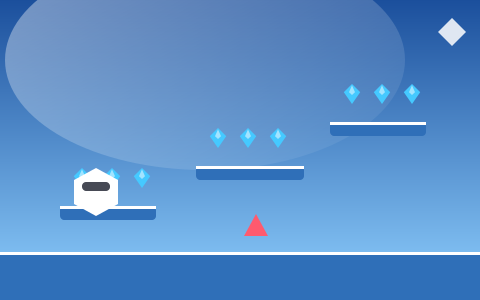
Jewel Jump — easy, platformer. Untimed and stage-based. Nothing moves until you do, so you can stand still and read the whole layout before committing. The jewel arcs are drawn on the actual jump curves, which means the gems tell you what your jump did wrong.
Crystal Factory — easy, catcher. The most relaxed game here. Crystals ride a conveyor belt before they fall, giving you a second or more of warning about where each one will land. Dropping a crystal costs nothing but your streak, so mistakes are cheap.
Underwater Crystal Quest — easy, exploration. The slowest movement on the site and the most generous clock. A gentle introduction to the search side of the genre, which is a completely different skill from the reflex side.
A sensible order
If you want a path rather than a list:
- Forest Gem Trail until you have held a five-times multiplier for a full minute. Do not skip this — it is the habit that makes everything else make sense.
- Sky Gem Collector to practise routing where nothing is fast enough to be an excuse.
- Jewel Jump to learn what a correctly executed jump feels like, with the gem arcs as feedback.
- Crystal Cave Collector for the search skill — generated caves, hidden crystals, a clock.
- Gem Rush for the same runner idea at medium difficulty, with a Rush meter that visibly rewards the chain.
- Endless Gem Collector as the benchmark. No gimmick, so improvement here means your technique improved.
That sequence covers runners, flyers, platformers, exploration and the benchmark, which is enough of the genre to know which direction you want to go next.
Three to save for later
Ultimate Gem Challenge — expert. Four lanes, the highest opening speed and hazard density on the site, and no gentle first thirty seconds. It assumes you already know the lane format from the three-lane games, and without that it is simply overwhelming.
Gem Jump Challenge — expert. Nothing in it is fast. Every difficulty is margin: narrow ledges, no double jump, no timer. It is a precision test that assumes you have already learned the jump somewhere more forgiving.
Neon Gem Run — hard. Opens at 380 pixels per second, which is roughly where Gem Rush arrives after a minute, and climbs to 760. Excellent once you can hold a chain under pressure, and dispiriting before that.
None of the three is unfair. They are all built to the same rules as the easy games — every hazard telegraphs, every wave has a safe route, the reaction window has a floor. They simply assume a foundation, and the foundation takes an hour rather than a week.
Key takeaways
- A good first game is slow enough that every miss is a decision rather than a reflex failure.
- Forest Gem Trail is the single best starting point on the site.
- Untimed games let you stand still and read the layout, which is the fastest way to learn to route.
- Save the two expert-tier games until you can hold a five-times multiplier comfortably.
Frequently asked questions
What is the best first game on this site?
Forest Gem Trail. Easy tier, the lowest hazard density here, continuous gem ribbons and a small permanent magnet — which together make it the easiest place to feel a long collection chain.
Should I start with a platformer or a runner?
Either. Platformers are untimed and let you read the layout before moving; runners teach line-holding. Trying one of each in your first session is a reasonable plan.
Which games should a beginner avoid?
Ultimate Gem Challenge and Gem Jump Challenge, both expert tier, and Neon Gem Run, which opens at a speed most games do not reach for a minute.
How long before these games get interesting?
Immediately, but the depth arrives when you stop chasing gems and start following routes. That usually takes a handful of runs.
Put it into practice
Reading about collection routes only gets you so far. Pick a game and try one idea from this guide on your next run.