Lane games are the most reduced form in the genre. There is no positioning, no height, no fine control — only which of a small number of rows you are in. That reduction is not a simplification; it is a focus, and what it focuses on is reading ahead.
The structure
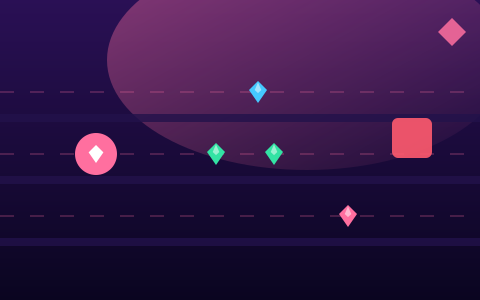
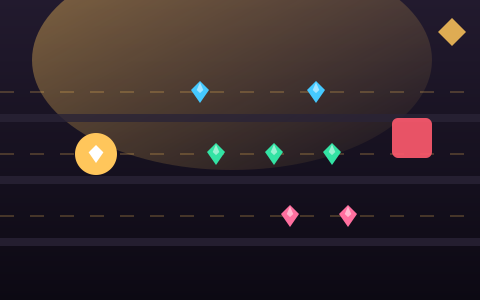
The play area is divided into horizontal lanes. Your character sits at a fixed horizontal position and moves between them. Content scrolls in from the right in waves — one item per lane, generated as a group.
A wave contains:
- One clear lane, carrying a line of two to four gems.
- Blocked lanes, carrying a hazard, chosen by the current difficulty's hazard probability.
- Neutral lanes, carrying a scattered single gem or nothing.
Waves arrive on an interval that tightens as the difficulty curve rises — from around 1.1 seconds down to 0.45 in our three-lane games, and from 0.95 to 0.4 in the four-lane one.
That is the whole structure, and everything interesting comes from how the safe lane is chosen and when you move to it.
The guaranteed safe lane
The generator picks the safe lane first, before placing anything else, and is then not permitted to block it.
The ordering matters. Decorating a wave with hazards and then hoping a gap survives produces occasional impassable waves, which are not obstacles — they are endings. Choosing the route first and decorating around it guarantees a way through at every difficulty, including the maximum.
The safe lane is also the one carrying the gem line, which means the reward and the survival route are the same route. That is a design rule we apply across the whole site, and nowhere is it more literal than here: if you can see where the gems are, you already know where to be.
Practically, that gives you a fast read. Do not scan the lanes for hazards. Look for the gem line — it is the answer.
Why four lanes are much harder than three
This is not a small difference and it is worth being precise about.
With three lanes, wherever you are, every other lane is at most one move away. The decision is binary: move or do not. The execution is one input.
With four lanes, the safe lane can be two moves away. That doubles the execution cost at exactly the moment you have the least time, and it introduces a decision that does not exist in three lanes: is there time to make two moves, or should I take the nearer risk?
Ultimate Gem Challenge is the four-lane game here, and it opens at 400 pixels per second — higher than any other game's opening — climbing to 780. At that speed a two-move switch is frequently not available, which is why the standing advice for that game is to stay in the middle two lanes by default, where everything is one move away.
The three-lane games — Rainbow Jewel Quest and Crystal Conveyor — teach the format. The four-lane one assumes you already know it.
Switching early is everything
Because the entire wave is visible from the moment it enters the screen, every failure in a lane game is a decision made late. There is no hidden information and no reflex component beyond executing a move you had already decided on.
That makes lane games the purest place to practise the habit that improves every game in the genre: deciding on entry rather than on approach.
The concrete rule: switch the moment a wave enters the screen. At higher speeds, entry and arrival are close enough together that any delay at all means you are moving as the wave reaches you.
The supporting detail is about gem lines. Because the safe lane carries a line of two to four gems rather than a single one, switching a fraction late does not cost you one gem — it costs the front of the line, and missing any of them breaks your chain. Switching early gets you all of it; switching late gets you the tail and a reset.
The other habit worth building, once entry-switching is automatic: look at the wave behind the current one. It often determines whether you should move now or hold, because the lane that is safe in this wave may be blocked in the next.
Rhythm versus escalation
Our two three-lane games use the same structure and feel quite different, which illustrates how much pacing does.
Crystal Conveyor runs on a mechanical rhythm. Visible conveyor belts move at a rate tied to the current speed, so the arrival rhythm is literally drawn on the screen. That makes counting viable: strong play there looks calm, because the player is moving on a beat rather than reacting to objects.
Rainbow Jewel Quest runs on escalation. A stage announcement every twenty-five seconds raises the speed, tightens the spacing and increases blocker density, with a compounding bonus attached. That gives runs a visible structure and pushes the late game toward survival once your multiplier is at its ceiling.
Same three lanes, same guaranteed safe route, same one-move switches. One rewards counting; the other rewards adapting. Worth playing both, because the skills transfer in opposite directions.
Key takeaways
- Every wave guarantees exactly one clear lane, chosen before anything else is placed.
- Three lanes means any safe lane is one move away; four means it can be two.
- Because the whole wave is visible on entry, every failure is a decision made late.
- Missing the front of a lane's gem line usually means missing the whole line.
Frequently asked questions
Is there always a way through?
Yes. The generator picks the safe lane first and is not permitted to block it, at any difficulty. A wave with no route would be an ending rather than an obstacle.
Why is a fourth lane so much harder?
Because in three lanes any safe lane is at most one move away. In four it can be two, and at high speed a two-move switch is often more than you have time for.
Should I chase gems in a neighbouring lane?
Only if it is one move and the lane is safe. Leaving a jewel line to grab a single gem usually breaks a chain worth more than the gem.
What is the fastest way to switch on a phone?
Swiping up or down on the play area. It is faster than the buttons and keeps your thumb where you can still see the screen.
Put it into practice
Reading about collection routes only gets you so far. Pick a game and try one idea from this guide on your next run.