A catcher is a collection game with its geometry turned around. Everything else follows from that, including why they are harder than they look.
The geometry is inverted
In a runner, the collectibles are fixed in the world and you move through them. You have two axes of control in a platformer, or one plus a jump in a runner, and your job is to find a line.
In a catcher, the collectibles move and you have a single axis. They arrive on their own schedule and you can only be in one place at a time.
That inversion has one enormous consequence: you cannot route around a problem. In a runner, an awkward cluster can be skipped and the run continues along a different line. In a catcher, two gems landing in different places at the same moment is not a problem you can avoid — it is a choice you have to make.
The second consequence is that the game controls the pace entirely. A runner's difficulty is partly in your hands, because you decide how aggressively to route. A catcher hands you a stream and asks how you will handle it.
Triage replaces routing
The skill in a catcher is not movement. The cart moves quickly, the screen is not wide, and reaching any single item is rarely difficult.
The skill is triage: when three things are in the air and two of them are heading for opposite corners, which do you take and which do you write off?
The decision has a few standing rules.
Take the more valuable one. If both cost the same to lose, there is no reason to save the cheaper one.
Stay near the centre by default. From the middle, both corners are reachable. From a corner, only one is. Returning to centre after each catch is the positional equivalent of holding a line in a runner.
Let hazards fall. The one genuinely free decision in the genre. Catching a crate costs a life; ignoring it costs nothing at all.
Decide early and commit. Starting toward one gem, changing your mind and ending up between two is the worst outcome available, and it is the most common failure in these games.
Information is the design problem
Because the player cannot avoid the choice, the entire design question in a catcher becomes: how early do you tell them what is coming?
Too late and the game is a reaction test with a random outcome. Too early and there is no tension.
Our two approaches sit at different points on that scale.
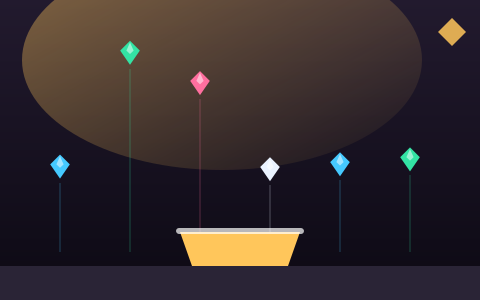
Conveyor preview. Crystal Factory has items ride a belt across the screen before they drop, drifting left or right for up to a couple of seconds. By the time anything falls, you have known where it would land for a second or more. That makes it the calmest game on the site, and the skill shifts from reaction to reading three overlapping belt paths at once.
Landing markers. Gem Catcher has no belts — gems fall straight down from the moment they appear. Instead, a small marker appears on the catch line under each falling gem, showing exactly where it will arrive. Less warning time, same certainty about the destination.
Both solve the same problem: making the choice solvable. A catcher where you cannot tell where things will land is not difficult, it is arbitrary — and the difference between those two is the whole of good catcher design.
What lives add
Catchers are the one place on this site where a lives system earns its keep, and it is worth explaining why we use one here and nowhere else.
Lives in arcade games are usually inherited from coin-operated economics — a way to make failure cost money. Reproducing that in a browser game is cargo cult design.
But in a catcher, a life does design work. Gem Catcher costs you a life for every dropped gem, not just for catching a hazard. That single rule transforms the triage decision: when two gems land apart, you are not choosing which to collect, you are choosing which to pay for.
Compare with Crystal Factory, where dropping a gem costs only your streak. The same situation is a mild disappointment rather than a real cost, and the game is correspondingly more relaxed.
Same genre, same geometry, one rule different, and two games that feel nothing alike.
Our three catchers
Crystal Factory — easy tier, conveyor preview, drops cost only your streak. The relaxed one, and a good first arcade catcher.
Gem Catcher — medium tier, landing markers, every drop costs a life, narrower catcher. The punishing one, where triage has real stakes.
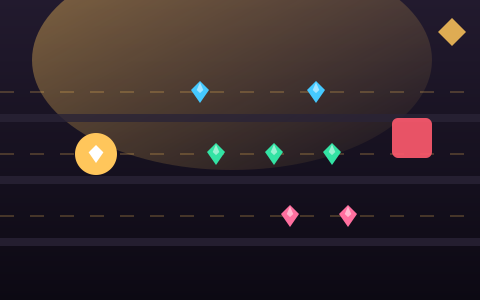
Crystal Conveyor — technically a lane game rather than a catcher, but it belongs in the same conversation. Three belts carry crystals and scrap horizontally toward you, and because the belt plates move at a rate tied to the current speed, the arrival rhythm is drawn on the screen. It is the version of this idea where counting beats reacting.
One practical note that applies to all three: drag, do not press. On a phone, dragging on the play area slides the catcher directly to your finger, which is considerably faster than a button at high fall speeds. A catcher asks a positional question, and a finger answers a positional question directly.
Key takeaways
- In a catcher the collectibles move and you have one axis, which turns routing into triage.
- A catcher lives or dies on how early it tells you where things will land.
- A lives system earns its place here, because it makes 'which gem do I abandon' a real decision.
- Drag-to-move beats buttons in every catcher, because a finger answers a positional question directly.
Frequently asked questions
Why are catching games harder than they look?
Because when two collectibles land in different places at once, you cannot have both. A runner lets you route around a problem; a catcher forces a choice.
What are the marks along the bottom of the screen?
Landing markers, in Gem Catcher. Each shows where a falling gem will arrive at the catch line, which is what makes the choice between two gems solvable rather than a guess.
Why does Crystal Factory use conveyor belts?
To give you information earlier. Items ride a belt across the screen before falling, so you know where each one will land a second or more in advance.
Should I use the buttons or drag?
Drag, in all three catchers. The cart slides straight to your finger, which is meaningfully faster than pressing a direction and waiting for acceleration.
Put it into practice
Reading about collection routes only gets you so far. Pick a game and try one idea from this guide on your next run.