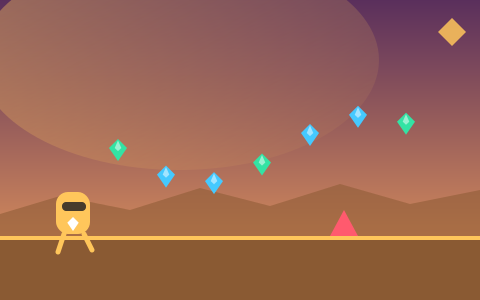
The slide is the most under-practised move in runner games, mostly because in most runners it barely matters. In one of ours it is the entire design, and the technique transfers to all of them.
The cue is a gem, not the barrier
The instinct is to slide when you see the barrier. At 500 pixels per second that is already too late, because the slide has a short start-up and the barrier is on you before it completes.
The design answer is a cue placed earlier. In Desert Jewel Dash, every low barrier comes with a line of treasure gems underneath it — and the first gem of that line is positioned before the barrier enters range.
That leading gem is the cue. When you reach it, slide. The barrier will arrive comfortably after your slide has settled, and the rest of the line is yours.
This is a general principle in the genre, worth noticing elsewhere: the collectible layout usually tells you when to act, a moment before the hazard tells you that you should have. A gem placed conspicuously early is almost never decoration.
Committing means giving something up
The slide is the only move in our runners that removes an option. While sliding you cannot jump.
That is deliberate, and it is what makes the timing interesting rather than automatic. A move with no downside is a move you always make as early as possible; a move that costs you your jump is a move you have to think about.
The generator knows this. In Desert Jewel Dash you will occasionally find a spike cluster placed just past a barrier, which means the slide you had to commit to is followed immediately by a jump you cannot make. The correct response is to recognise that shape before committing — which means reading past the barrier rather than at it.
Practically: before you slide, look at what is behind the barrier. If it is clear, slide on the cue and take the whole treasure line. If something is waiting, either release the slide early and give up the back half of the line, or skip the line entirely and stay upright.
Giving up half a line breaks your chain, so the second option is often correct even though it feels worse.
Consistency beats reaction
If you are clipping barriers repeatedly, the fix is not to react faster. It is to slide earlier by a fixed amount, every time.
This is worth spelling out because the instinct is wrong. A player who keeps clipping tends to try to concentrate harder and respond quicker, which produces variable timing — sometimes early, sometimes late, and the late ones still end runs.
A fixed early trigger produces consistent timing. Sliding a quarter of a second earlier than necessary costs nothing at all: you are already low, the barrier passes, and the treasure line is collected either way. There is no penalty for being early and a total penalty for being late.
Whenever an action has that asymmetry — free to be early, fatal to be late — the correct technique is always to build a deliberately early habit rather than to sharpen your reactions. The same logic applies to lane switches, gravity flips and beam timing.
Reading the feedback
Two signals confirm a slide is actually happening, and both are worth using because at speed you cannot afford to look directly at your character.
Dust particles. Sliding kicks up dust behind you in Desert Jewel Dash. It is peripheral, it is unmistakable, and it tells you the input registered — which matters when you have pressed a button and are not sure whether it took.
The treasure line. The better signal. If you are collecting the gems under the barrier, you are low enough. If the line is passing above you, you are still upright and about to find out.
That second one is an example of something this genre does repeatedly: the reward layout doubles as feedback on your execution. It is the same principle as gem arcs telling you what your jump did wrong, and it is why paying attention to which gems you are collecting is more useful than watching your character.
If you want to practise the slide specifically, Desert Jewel Dash puts a barrier in roughly half its chunks, which is far more frequent than Gem Rush or Endless Gem Collector. Twenty runs there will build the habit; it then transfers unchanged to every other runner that has one.
Key takeaways
- The first treasure gem of the line under a barrier appears before the barrier does — that is the cue.
- You cannot jump while sliding, so committing means giving up your response to whatever comes next.
- Fix repeated clips by sliding earlier by a fixed amount, not by trying to react faster.
- Dust particles confirm the slide registered, which matters more than it sounds at speed.
Frequently asked questions
When exactly should I start sliding?
When you reach the first treasure gem of the line under the barrier. That gem is placed before the barrier specifically to act as the cue.
Can I jump out of a slide?
No. Committing to a slide means giving up your jump for its duration, which is what makes the decision interesting rather than automatic.
Why do I keep clipping barriers?
You are sliding late. Because the slide has a short start-up, reacting to the barrier is already too late at speed — start on the cue gem instead.
Which games have a slide?
Gem Rush, Desert Jewel Dash, Endless Gem Collector and Gem Collector Ultimate. Desert Jewel Dash is the one built around it.
Put it into practice
Reading about collection routes only gets you so far. Pick a game and try one idea from this guide on your next run.