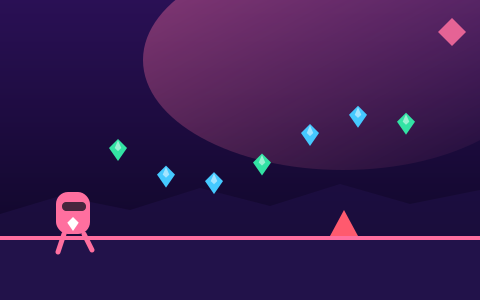
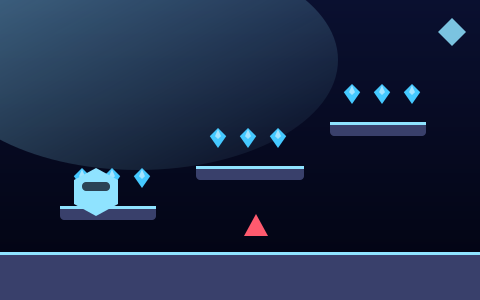
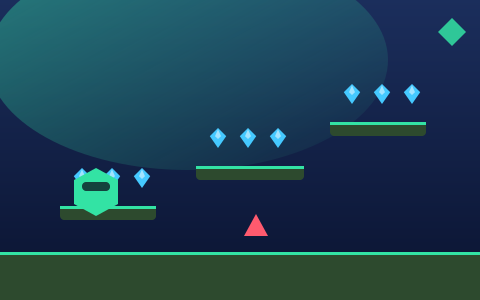
The double jump is one of the few mechanics that changes a level's layout as much as it changes the player's options. Understanding what it is actually for — and what it is not for — is worth a surprising amount of score.
What it actually changes
Mechanically it is simple: while airborne and having not yet used it, a second press applies another upward impulse at around 86 per cent of the first.
That produces two capabilities, and they are not equally understood.
Extra height and reach. The obvious one. The combined arc goes higher and further than a single jump, which puts additional gems and platforms in range.
Mid-arc direction change. The underrated one. Because the second jump resets your vertical velocity, it effectively restarts the arc from wherever you are — and combined with air control, that lets you change where you are heading partway through a jump.
The second capability is what strong players use it for. In Moon Crystal Hopper, where gravity is a third of normal and air control is full, the second jump used at the apex is primarily a steering tool: it redirects a long floaty arc toward a cluster that was never on your original line.
Extend, do not rescue
Here is the habit worth building: the double jump is for extending a line, not for rescuing a bad first jump.
Most players use it reactively. They jump, realise they are going to fall short, and press again. That works, and it means the second jump is spent every single time on correcting rather than on reaching.
The cost is real. Layouts in games with a double jump deliberately place some gem arcs above single-jump apex height — those arcs are only collectable with the second jump, and they are usually the highest-value part of the chunk. A player who has already spent their second jump correcting arrives underneath them.
The alternative habit: fix the first jump instead. Almost every short jump is caused by starting from too far back rather than by insufficient power. Running to the very edge before jumping solves it, and leaves the second jump available for what it is for.
A useful drill: play a run where you are forbidden from using the second jump defensively. Only use it to go higher than a single jump reaches. You will fall more often at first, and your first jumps will get noticeably better within a few runs.
How layouts change when it exists
A double jump is not a free addition to a game. It changes what the level generator is allowed to do.
Vertical range roughly doubles. Gem arcs can be placed higher, and columns of collectibles can be stacked taller. Neon Gem Run uses this explicitly: its energy-stone columns past each beam gate are placed so that reaching the top of one requires the second jump.
Gaps can be wider. Our runner chunk templates size their pits against the jump distance available, and the available distance is larger when a double jump exists.
The recovery margin grows. A player with a second jump can survive a mistimed first one, which means the generator can place slightly tighter arrangements without them becoming unfair.
That last point cuts both ways, and it is the reason the double jump is not simply a generosity. Because the generator accounts for it, a player who habitually spends it on corrections is effectively playing a game tuned for a capability they no longer have when it matters.
Games that deliberately omit it
Four of our platformers have no double jump, and in each case it is a decision rather than an omission.
Gem Jump Challenge. The expert-tier precision platformer. Every gap on every stage is clearable with one well-positioned jump, and the entire test is whether your approach position is right. A double jump would let you ignore positioning, which would remove the game.
Ice Crystal Run. The challenge is momentum, not height. Adding an air-recovery option would soften exactly the commitment the low friction creates.
Jewel Jump. The beginner platformer, where a single variable-height jump is the thing being taught. Two jump mechanics at once is one more than a first platformer should have.
Pixel Gem Adventure. Heavy, deliberate movement across very wide stages. The weight is the character, and a double jump would lighten it.
The general rule, worth applying when you meet a new platformer: if a game has no double jump, it is testing your approach. When a gap feels impossible in one of these, the fix is where you start the jump, not how you finish it.
Key takeaways
- A double jump extends reach and — more importantly — lets you change direction mid-arc.
- Using it to rescue a mistimed first jump wastes it; the clusters that need it are the ones above your normal apex.
- Layouts with a double jump place gem arcs above single-jump height on purpose.
- Games without one are testing approach position, and adding one would remove the test.
Frequently asked questions
Which games have a double jump?
Gem Rush, Neon Gem Run, Forest Gem Trail, Magnet Gem Rush, Endless Gem Collector, Gem Collector Ultimate and Moon Crystal Hopper. The other platformers deliberately do not.
Is the second jump as strong as the first?
Slightly weaker — around 86 per cent of the first jump's power in our runners. That is enough to extend an arc meaningfully without making the first jump irrelevant.
When should I use it?
To reach a gem cluster placed above your single-jump apex, or to change direction mid-arc. Not to fix a jump you started too late.
Why do some games not have one?
Because they are testing approach position. In Gem Jump Challenge, every gap is clearable with one well-positioned jump, and a double jump would let you ignore positioning entirely.
Put it into practice
Reading about collection routes only gets you so far. Pick a game and try one idea from this guide on your next run.