
Featured
Gem Rush
Sprint through a prism canyon, chain gems without missing and fill the Rush meter to speed the whole world up.
Search every game, category and guide on the site. Matching happens entirely in your browser — what you type is never sent anywhere.
Try a shorter term, a mechanic like “magnet” or “combo”, or browse the full library instead.
The full library, ready to browse without searching.
Sprint through a prism canyon, chain gems without missing and fill the Rush meter to speed the whole world up.
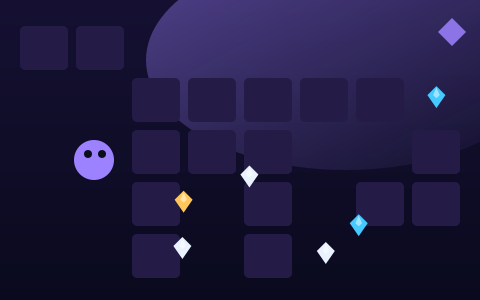
Explore a generated cave by lamplight, reveal hidden crystals and clear every one before the timer runs out.
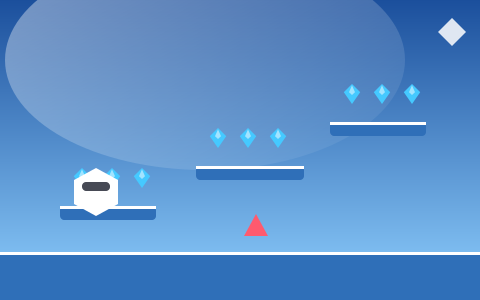
Jump between drifting sky platforms, clear every floating jewel on the stage and move on to a bigger one.

Sprint a neon skyline, thread blinking beam gates and collect energy stones at speeds other runners never reach.
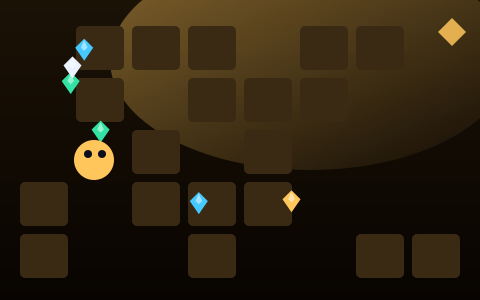
Navigate a generated maze, collect every gem in it and reach the exit before time runs out.

Fly an open sky with direct vertical control, sweep through gem arcs and dodge drifting hazards.
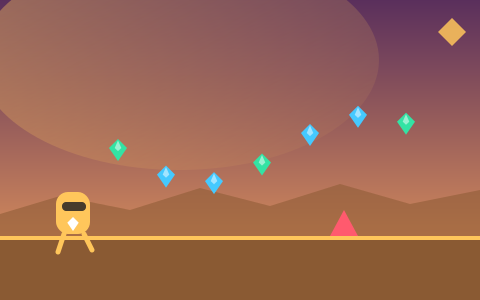
Dash across desert dunes, slide under low barriers and sweep the treasure lines hidden beneath them.
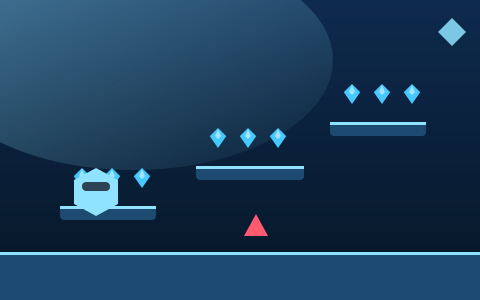
Platform across frozen ledges where momentum carries you further than you expect, and clear every ice crystal.

Thrust through an open star field, thread gem rings and manage momentum with no drag to help you.
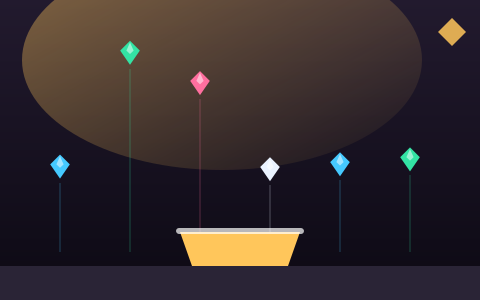
Work the floor of a crystal plant: read the conveyor belts, catch what they drop and dodge the scrap.

Search a fortress of halls and chambers for hidden treasure, dodge patrolling guards and reach the exit.
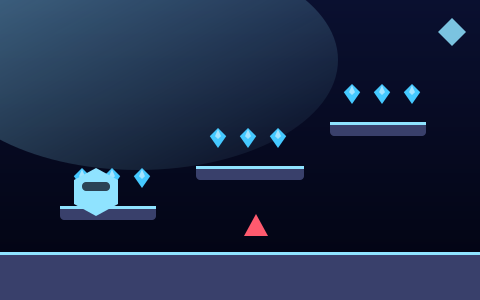
Hop between lunar platforms in a third of normal gravity, steer through long floaty arcs and clear every crystal.

Follow long ribbons of gems through a forest run, with a permanent magnet and the gentlest curve on the site.

Switch between three lanes to sweep jewel lines and dodge blockers through escalating colour stages.

Fly a rocket through a shrinking cavern corridor, following the gem line down the centre of the safe channel.

A single-input collector: tap to flip gravity between floor and ceiling and sweep the gems on the safe side.

A runner built on one continuous decision: charge a wide magnet field and slow down, or stay fast and narrow.

Catch falling gems below a cavern ceiling where every drop costs a life, and choose which gem to abandon.

A planning game: aim a cannon, charge the power and fire a collector that sweeps gems along its flight path.

Roll and flip your way around a lunar chamber, reaching crystals on both the floor and the ceiling.
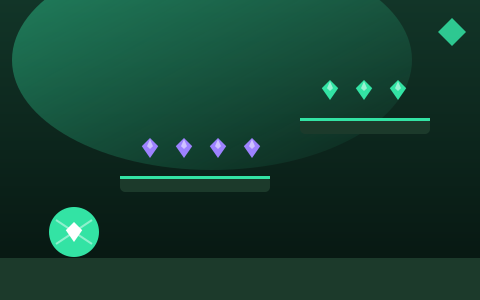
Roll a crystal sphere through woodland chambers, carrying momentum along gem lines laid on natural roll paths.
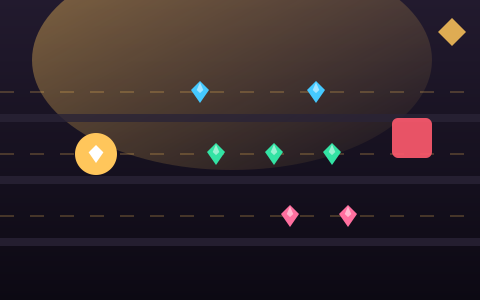
Switch between three conveyor belts to sweep crystals and dodge the scrap arriving on a mechanical beat.

Sweep wide mine tunnels for buried treasure while a runaway cart rattles through the passages behind you.
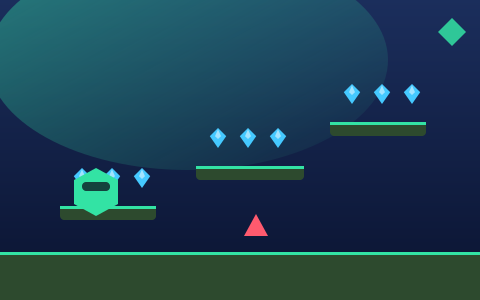
The precision platformer: small ledges, one jump, and gem arcs that show you exactly what a perfect jump looks like.

Dive a flooded reef, glide through coral corridors and gather every crystal before your air runs short.
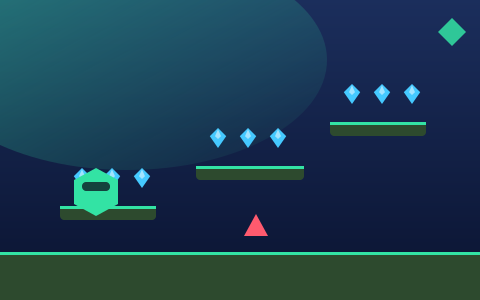
A wide, blocky platform adventure with weighty jumps and gems tucked into every corner of the stage.
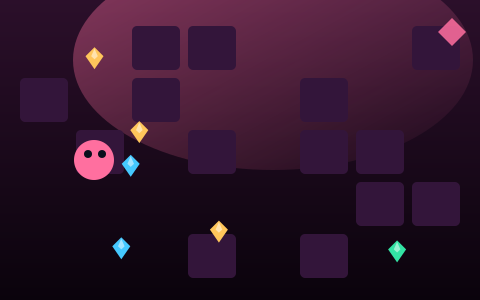
Gather gems in a braided maze while three arcade creatures patrol the corridors — no timer, just the chase.

The benchmark endless run: every mechanic the engine offers, no special layer, and a curve that keeps rising.

The expert lane game: four lanes, no easing in, every power-up available and every hazard type in play.

The flagship run: every thirty seconds the game changes character, demanding a different collection skill each time.
Every article on the site.
The genre explained properly: what makes a game a gem collection game, how the six main sub-types differ, and why collecting is a stronger mechanic than simply scoring.
What happens between you touching a gem and the number changing — collection detection, pattern spawning, streak rules, hazard cycles and the feedback loop that ties them together.
Seven strategies that reliably raise a collection score, ranked by how much difference they make — starting with the one almost everyone gets wrong.
Why combo systems exist at all, what a multiplier is really doing to your score, and the design decisions — step size, ceiling, reset condition — that make one feel fair.
There are two different multipliers in most collection games and they do not work the same way. Here is what each one does, how they stack, and when to spend one.
Both are short, both are score-driven, both end when you make a mistake. The differences are in where the reward lives and what a mistake costs — and those two change everything.
You cannot make your reaction time much faster. You can make the decision arrive much earlier, and that is worth far more — here is how.
The four variables an endless game actually raises, the curve shape that makes a run feel good, and why a game that gets harder forever is just a timer in disguise.
In a good collection platformer, the gems are a drawing of the jump you are meant to make. Here is how that works, and how to read it.
Six power-ups, six different rewrites of the routing problem. What each one really does, when it is worth taking, and the mistakes that waste them.
How a maze is carved, why braiding matters more than it sounds, how hidden collectibles change a search, and the sweep patterns that beat wandering.
Physics moves the interesting decision earlier in time. That is the whole reason to use it — and the reason bad physics games feel unfair.
Seven rules that separate a hard collection level from an unfair one, with the reasoning behind each and the failure it prevents.
Nine shapes, each of which says something different to the player. How they are built, how spacing is derived, and how they combine into a level.
Feedback, completion and tension explain most of why collecting feels good — and the same mechanisms explain where the genre can turn manipulative if nobody is careful.
What actually happens when a browser game saves your score, why local storage is the right tool, the four ways it fails, and why we call it a local best.
Touch is not a keyboard with worse ergonomics. Here is how control placement, canvas scaling and gesture choice actually change a collection game.
What a canvas game can and cannot do for accessibility, the measures that genuinely help, and an honest account of where we fall short.
Pure noise produces layouts that are occasionally impossible and usually meaningless. Templates with randomised parameters produce neither — here is how they are built.
The whole subject in one place — systems, sub-types, scoring, strategy, difficulty, technology and a path through the library from beginner to expert.
Where to start, the single habit that improves everything else, and the five mistakes nearly every new player makes.
Collection rate is gems per second, and the biggest lever on it is not your speed — it is how few direction changes your line requires.
Six hazard shapes, one cycle of observation, and the single rule that prevents most collisions: cross behind, never in front.
A trail is the most expressive collectible pattern there is. Here is how to build one that reads as a route rather than a queue.
Seven things a collection game must get right, and the specific failure each one prevents.
One button, one question per pattern, and one counter-intuitive rule: the players who tap least score most.
A magnet widens your line rather than moving it. That distinction explains when it is worth a fortune and when it is worth nothing.
Your results screen tells you which of three problems you have. Fixing the wrong one is why practice sometimes does nothing.
Balance is not about making things equally hard. It is about making sure every choice in front of the player is a real one.
Canvas, a loop, and a few hundred lines of JavaScript. What an HTML5 arcade game is actually made of, without the jargon.
What happens between your thumb touching the screen and the character moving — and why the buttons are where they are.
An endless run has three phases and each one wants a different approach. Playing all three the same way is why runs end where they do.
Hundreds of gems per run, sixty frames a second, on a phone. The techniques that make that comfortable rather than marginal.
Six specific changes that add distance, ordered by how much difference each one makes.
What a collectible actually is inside a game, how value tiers are built, and why the shapes matter as much as the colours.
Reading a pattern instead of a gem is the habit that separates calm play from busy play. Here is how to build it.
Five causes, each with a different fix. Identifying which one you have takes one run of paying attention.
The take-or-skip call, reduced to three questions you can answer in under a second.
A shield does not make you safer. It makes a different route correct — and knowing which route is the whole skill.
The only power-up on this site that can actively lose you a run. Here is how to tell which situation you are in.
The vacuum removes the routing problem entirely for five seconds. Its brevity is what stops it being a solution to the whole game.
Every other power-up changes how you collect what the game generated. This one generates its own.
Some of these games are genuinely better on a phone than on a keyboard. Here is which ones, and how to hold it.
Five games to start with, what each one teaches, and three to save for later.
Some of these games want ten minutes. These ones want ninety seconds, and give you a complete experience in it.
Three sweep patterns ranked by how much ground they cover per second, and the one place the last two gems are always hiding.
Hiding collectibles turns navigation into search. The ratio hidden is one of the strongest levers in the whole genre.
A timer is not just pressure. It changes which strategy is correct, and removing one inverts the whole game.
Clearing a timed level is a coverage problem, not a speed problem. The distinction is what separates a clear from a timeout.
Reduce movement to a single question and the whole game becomes about when you answer it.
In a runner you go to the gems. In a catcher they come to you, and that single inversion changes every decision.
The slide is the only move in a runner that takes away your other options. Timing it is a commitment problem, not a reflex one.
A double jump is not a second chance. Used as one, it costs you more routes than it opens.
Cut gravity to a third and the skill moves from the moment of the jump to the second after it.
Change deceleration and you change what the game is about. The jump does not have to move at all.
Multiply one vector by minus one and you get a mechanic with real depth. Here is why.
Remove execution entirely and you get a planning game. It only works if the physics are visible.
A rolling character cannot pick at a gem line. It has to sweep one, which changes how the whole level is laid out.
Which gems you missed tells you exactly what your jump did wrong. It is the most precise feedback in the genre.
Three affordances you never notice, each removing a category of failure that taught you nothing.
Three ways a hazard can warn you, and the rule that makes all of them work: nothing appears where the player already is.
Two numbers adjusted a few pixels in opposite directions, and a game stops feeling arbitrary.
Particles are feedback, not decoration. Which is why the budget matters as much as the burst.
Turning the sound on is genuine advice, not a preference. Here is what the audio is actually telling you.
One scheduling function, one accumulator, and a handful of guards. That is the whole loop.
Two sizes, one ratio and one transform. The difference between a crisp game and a blurry one.
The browser stops calling your loop. That is not the same as pausing your game, and the difference matters.
Ordinary play improves you slowly. A twenty-minute structured session improves you faster than an hour of it.
Thirty games, nine archetypes, six skills. Here is how to pick the one that actually suits what you want to do next.
Ten habits that cost score, in order of how much. Most players have at least four of them.